

Somewhere right now, a team is sitting in hour two of a workshop that could have been ten minutes.
There’s a slide deck. Someone is presenting. Two people are doing most of the talking.
Everyone else is nodding, checking their phones under the table, and mentally composing their lunch order.
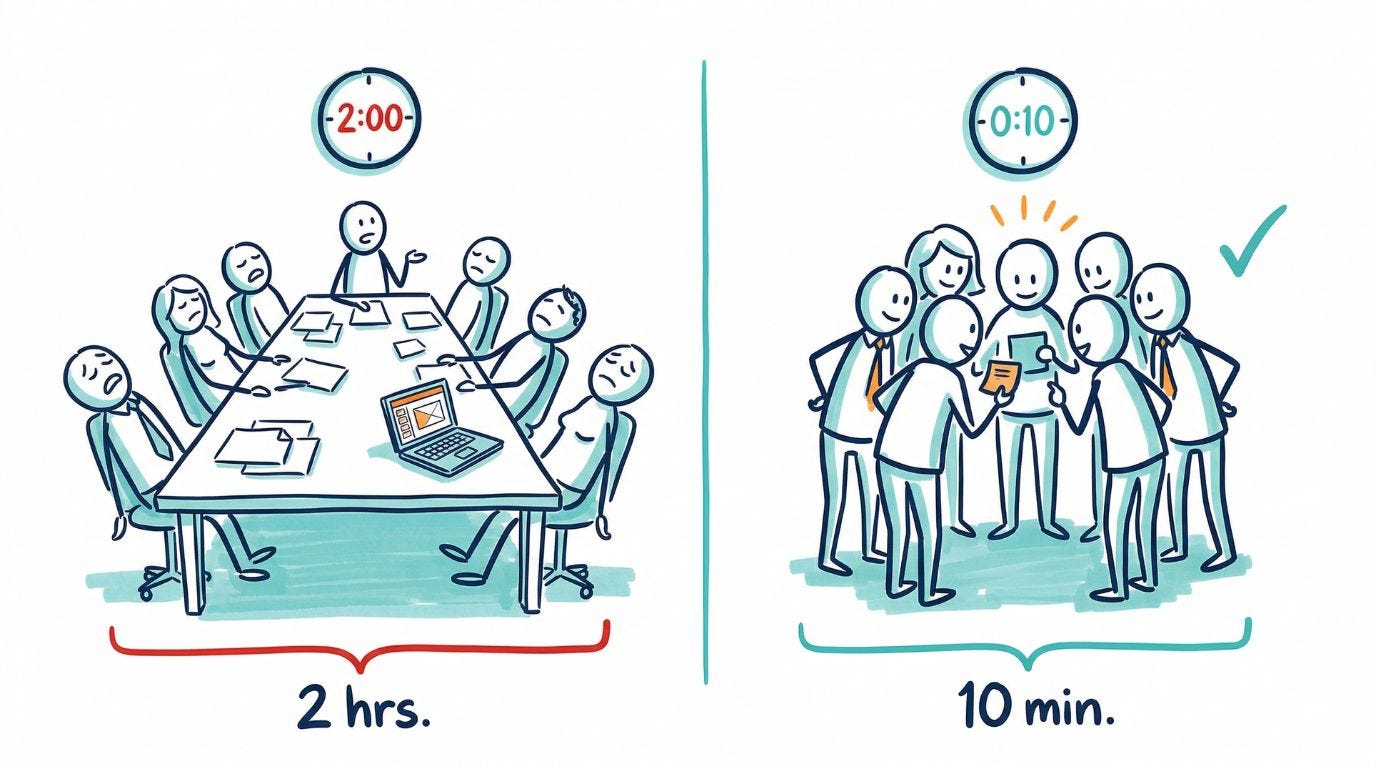
Forty-five minutes later, no decisions made. Someone suggests a follow-up meeting. Everyone agrees, because agreeing is easier than admitting the last hour was wasted.
Here’s what’s strange: the team didn’t need a workshop. They needed ten minutes and the right structure.
Most meetings fail for the same reason. Not because people don’t care. Not because the team is dysfunctional. Because there’s no format.
Someone talks. Someone reacts. A third person brings up something loosely related. The conversation spirals.
And without a structure to land the plane, the meeting ends with a vague sense that “we covered a lot” but no clear next step.
This is understandable. Most managers were never taught how to run a structured meeting. They inherited the format from whoever managed them, which was usually “get everyone in a room and talk until the time runs out.”
The assumption is that more discussion leads to better decisions. But discussion without structure is just noise.
The fix isn’t a longer meeting. It’s a shorter one with a better format.
The 3-3-3 Check-In
Three questions. Three minutes each. Nine minutes of structured conversation that gets more done than most hour-long meetings.
Here’s the format:
3 minutes: What’s working?
3 minutes: What’s stuck?
3 minutes: What’s the one thing we should do about it?
That’s it. One decision. One owner. One deadline. Done in under ten minutes.
Simple to describe. But each block does more than it looks like on the surface.
The sequence matters. The constraints matter. And the places where most teams break the format are exactly the places where the value lives.
Block 1: What’s Working? (3 minutes)
Go round the room. Each person names one thing that’s working well right now. One sentence. No stories. No caveats.
“Client handoffs are smoother since we changed the template.”
“The new standup format is saving us time.”
Most people hear this question and think it’s a warm-up. A soft start before the real work. It’s not. It’s the most strategic question on the list.
Here’s why.
Most teams have no idea what’s going well. They never talk about it.
Every meeting jumps straight to problems, fires, blockers, complaints.
So when something is working, nobody protects it. Nobody names it. And then someone changes a process, restructures a team, or “improves” something, and accidentally breaks the thing that was working fine.
Starting with “what’s working” gives you data on what to protect, not just what to fix.
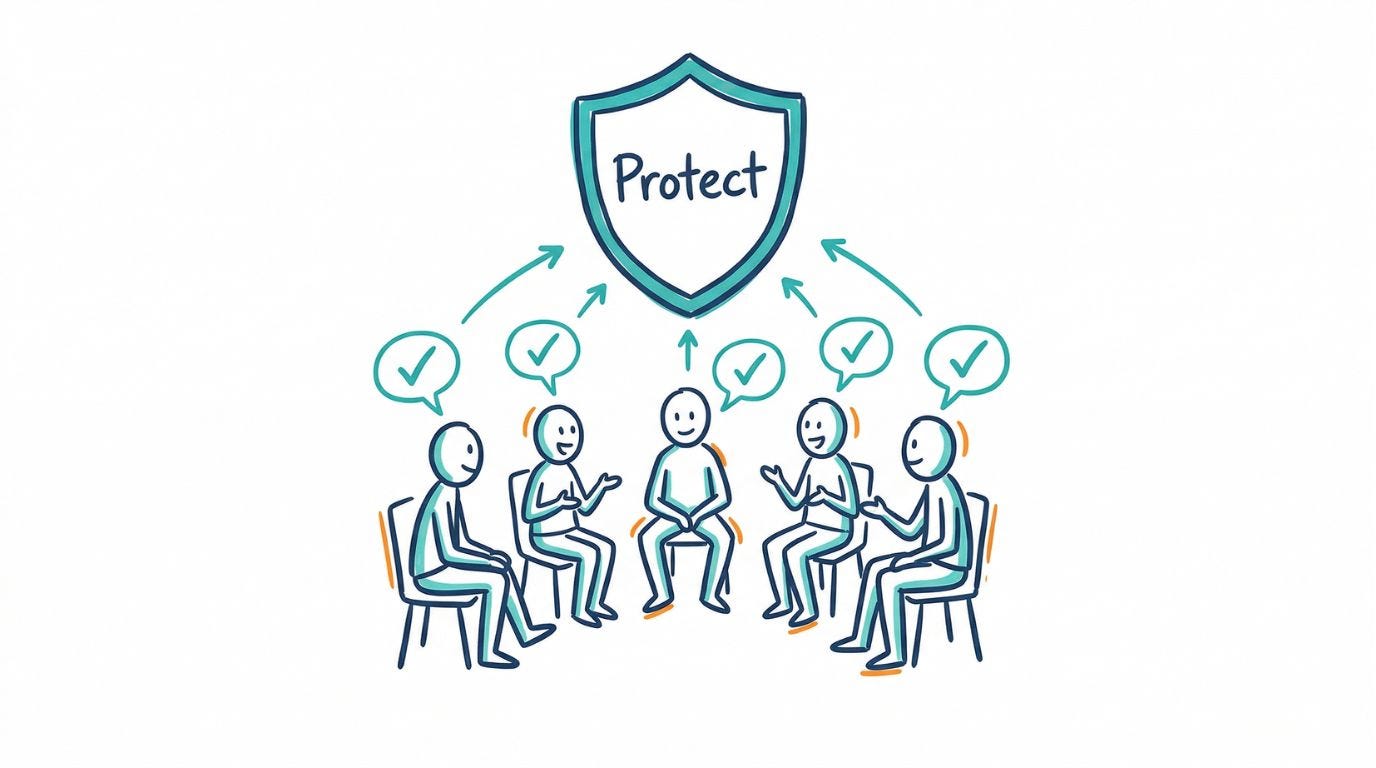
There’s a second effect that’s harder to see.
When you start with problems, the energy in the room drops immediately. People get defensive. They brace for blame.
But when you start by naming what’s going well, the tone shifts.
People arrive at the “what’s stuck” conversation from a position of competence, not crisis.
They’ve just heard evidence that things are going right. That changes how they talk about what isn’t.
If you skip this block or treat it as optional, you lose both effects. Keep it.
Block 2: What’s Stuck? (3 minutes)
Same format. Each person names one thing that’s stuck, blocked, or frustrating. One sentence.
“I’ve been waiting nine days for sign-off on the proposal.”
“We keep revisiting the pricing decision and nothing gets finalised.”
Here’s the rule that makes this block work: no solving yet.
That’s harder than it sounds. The instinct in every team is to hear a problem and immediately start fixing it.
Someone says “the proposal is stuck” and within seconds, three people are brainstorming solutions, someone is volunteering to send an email, and the meeting has been hijacked by one issue while six other people never got to speak.
Twenty minutes later, you’ve solved one thing and heard from two people. That’s not a meeting. That’s a conversation between two people with an audience.
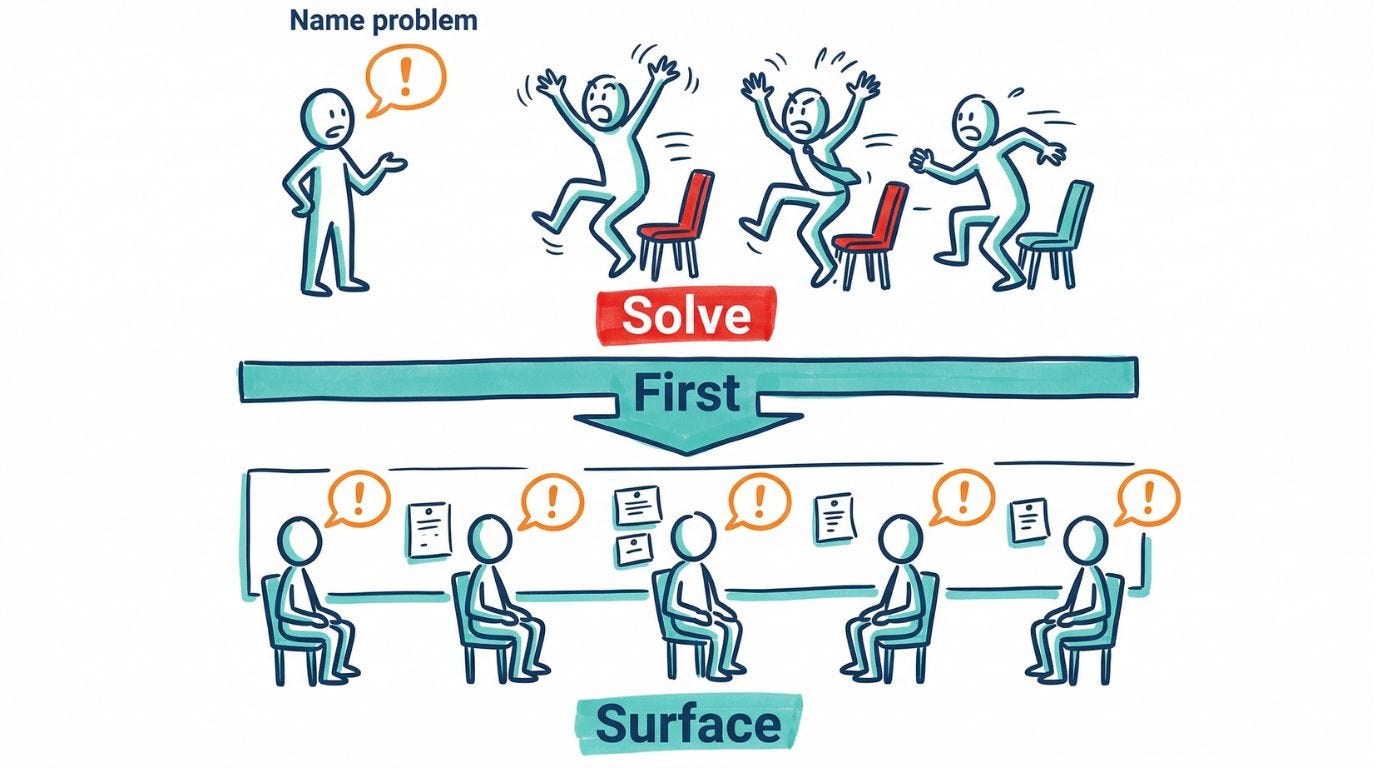
The “no solving yet” rule forces a different sequence.
Surface everything first. Get every stuck item visible. Then, and only then, pick the most important one and solve it.
That sequence matters because the most important problem is rarely the first one mentioned. It’s usually the third or fourth. And you’ll never get to it if you let the group rabbit-hole on whatever came up first.
If you’re facilitating this block, your only job is to stop people from solving.
“Good. Park that. We’ll come back to it. Who’s next?”
That’s all you need to say.
Block 3: What’s the One Thing We Should Do About It? (3 minutes)
Not five things. One.
The team looks at everything that was surfaced in block two and picks the most important stuck item. Then they agree on a single next step.
One owner. One action. One deadline.
“Sarah will get final sign-off from James by Thursday. If she doesn’t hear back by end of day Wednesday, she’ll escalate to his manager.”
That’s a decision. It has a name, an action, and a date. It will either happen or it won’t, and everyone will know which one.
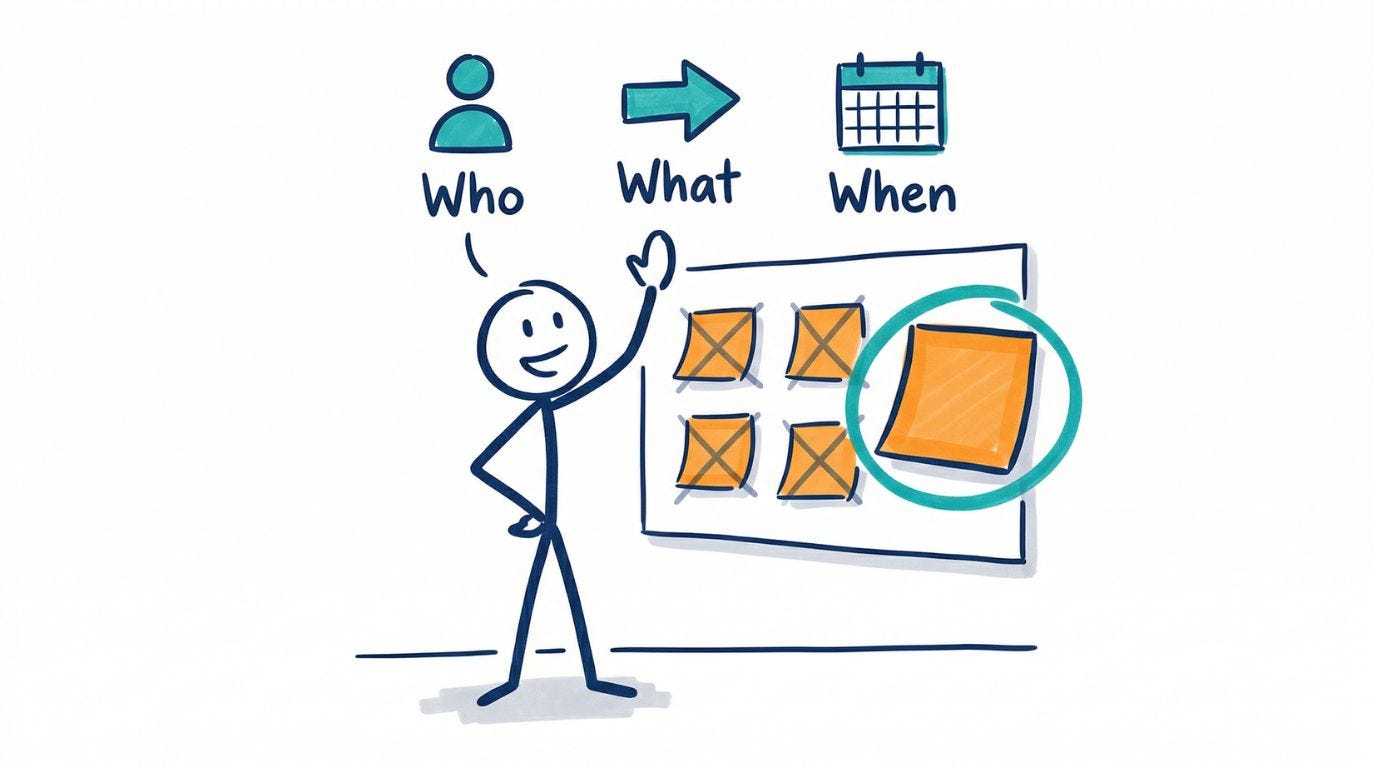
Compare that to how most meetings end: “OK, so we’ll all try to follow up on that and touch base next week.”
No owner. No specific action. No deadline. That’s not a decision. That’s a wish.
The constraint of “one thing” is what gives this block its power.
Teams want to solve everything. They want to leave the meeting with five action items and a full project plan.
But five action items with no owners and no deadlines is worse than one action item that actually gets done.
One real commitment beats five vague intentions every time.
What Happens When Teams Resist
The most common pushback from managers: “My team won’t say what’s stuck in front of each other.”
That’s a real concern. But it’s a trust problem, not a format problem.
If people don’t feel safe naming blockers out loud, that tells you something important about your team. The 3-3-3 didn’t create that problem. It surfaced it.
If that’s your situation, there’s a simple adaptation. Start with written responses instead of spoken ones.
Everyone writes their “stuck” item on a sticky note. Put them on a wall or a shared board. Read them out anonymously. You get the same data without the exposure.
Run it this way for a few weeks. As people see that naming problems leads to solutions (not blame), the trust builds.
Move towards spoken answers over time. The written version is the bridge, not the destination.
The second most common pushback: “We have too many people for this.”
The format works well with groups of six to ten.
Beyond that, you have options. Break into smaller groups of four or five, run the 3-3-3 in parallel, then bring everyone back for a quick share of the most important stuck items.
The plenary share adds a few minutes, but you keep the structure and the constraint.
One team leader I heard from ran a version of this with 43 people during complex operations cut-over meetings.
Each person took about a minute once they got used to the format. It scaled because the structure held.
Without the structure, 43 people in a room is chaos. With it, it’s data.
The 10-Minute Constraint
The biggest threat to the 3-3-3 is letting it run over.
Ten minutes means ten minutes. Set a timer. When the timer goes off, the meeting is done.
If a topic needs more time, schedule a separate conversation. Don’t extend the check-in.
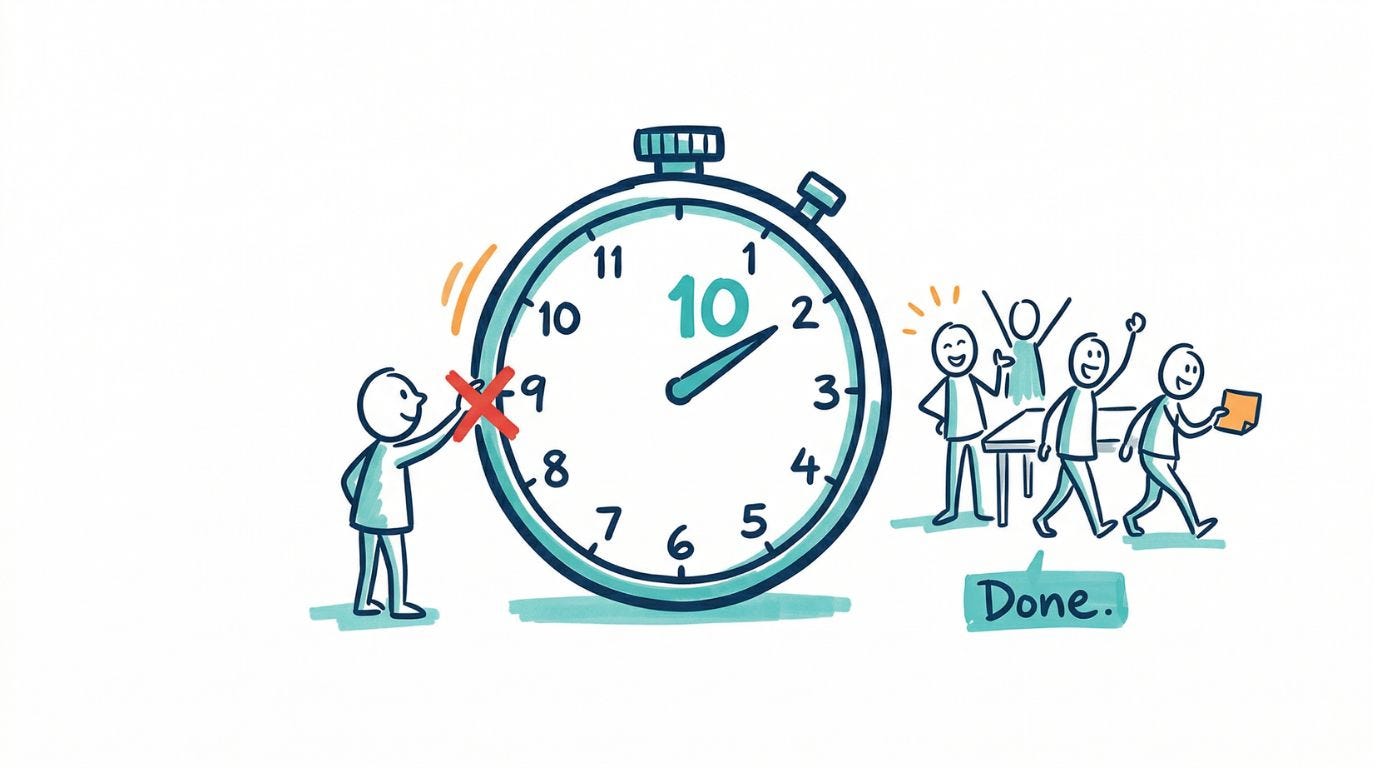
This feels ruthless the first time you do it. Someone is mid-sentence and the timer goes off. A problem feels half-discussed.
The instinct is to say “let’s just take five more minutes.” Don’t.
The power of this format lives in the constraint.
A ten-minute meeting that always runs to twenty-five is just another meeting.
A ten-minute meeting that always ends at ten builds a different kind of discipline.
People learn to be concise. They learn to prioritise. They learn that if something needs more time, it gets its own meeting, not a hijack of this one.
Remove the constraint and the format collapses. Protect it.
What Happens at Week 3
The most interesting thing about the 3-3-3 isn’t what happens in the first meeting. It’s what happens after three or four weeks of running it consistently.
Around week three, something shifts.
People stop saving problems for the big monthly review or the quarterly offsite.
They start surfacing smaller issues earlier because they know there’s a reliable space for it every Monday (or whenever you run it).
Issues that used to grow into full-blown crises get caught when they’re still small and easy to fix.
The format doesn’t just solve problems. It prevents them.
This is the compounding effect that you don’t see from a single use.
A one-off 3-3-3 is useful. A weekly 3-3-3 becomes a team operating rhythm.
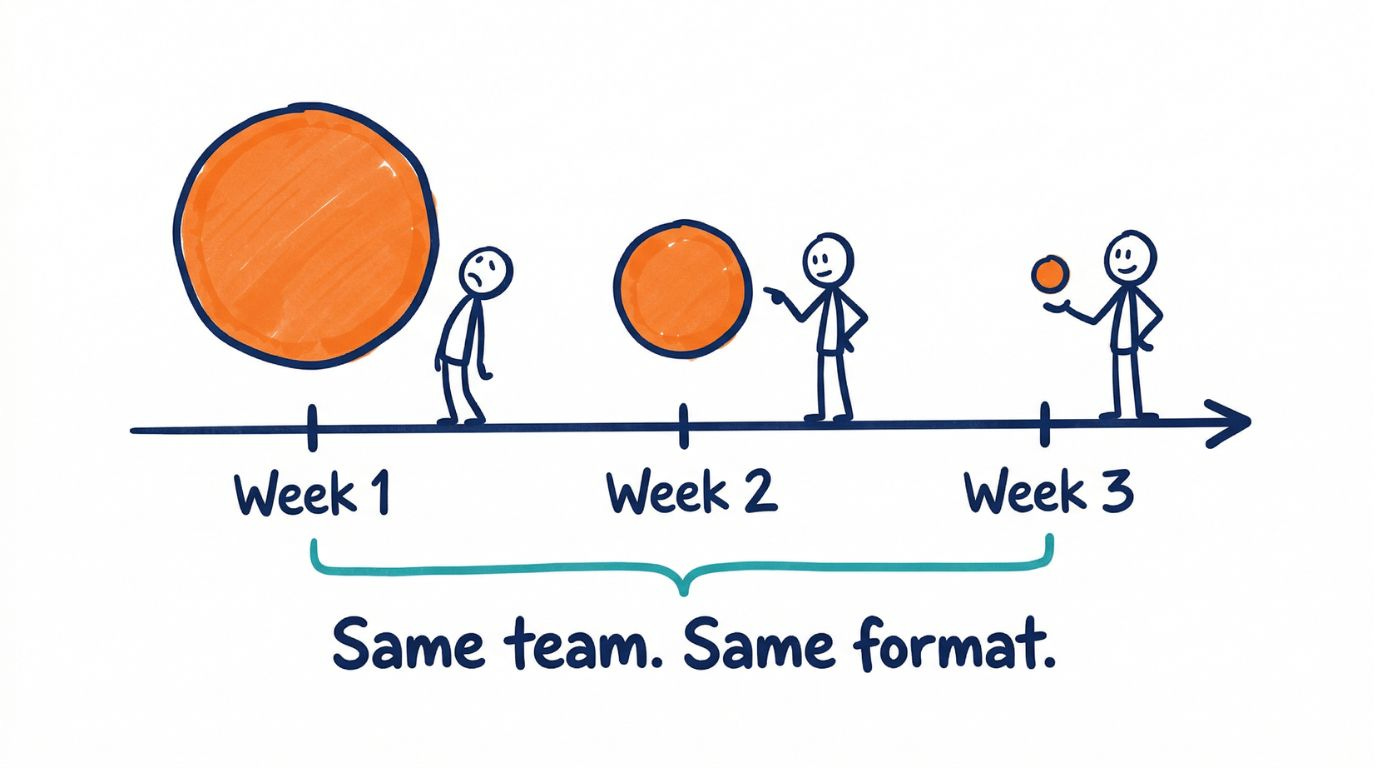
Over time, the team develops a habit of naming what’s working (so you protect it), naming what’s stuck (so you fix it early), and making one clear decision per week that has a name, an action, and a date.
After a few months, you have a team that surfaces problems early, makes decisions quickly, and follows through. That’s not a meeting format. That’s a culture.
Where to Use It
The 3-3-3 bolts onto almost any regular meeting. The best entry points:
The first ten minutes of your Monday team meeting: This turns a standing meeting into a decision-making rhythm without adding any time. You’re already in the room. Give the first ten minutes a structure and the rest of the meeting gets sharper too.
The start of any project check-in: Before the status updates, before the slide deck, before someone shares their screen and everyone watches them scroll. Ten minutes of 3-3-3. Then continue with whatever you had planned.
A standalone daily sync for teams in a crunch period: When things are moving fast and decisions need to happen daily, a 10-minute 3-3-3 every morning is worth more than a 90-minute weekly review.
You don’t need a two-hour workshop to move your team forward. You need ten minutes, three questions, and the discipline to stop when the timer goes off.
Most teams are over-meeting and under-deciding.
More time in the room doesn’t fix that. Better constraints do.
The best meeting your team has this month won’t be the longest one.
It’ll be the shortest one that actually produces a decision.
If this was useful, forward it to someone or share it with your network. They’ll thank you.
More frameworks like this every week. Subscribe to get them in your inbox.
If all companies applied this super-simple strategy, there would be so much more time to work on useful things than to spend on useless meetings. Great post btw!
The 3-3-3 works because it forces the one thing most workshops avoid: admitting that attention is the scarce resource, not time. Ten minutes of focused input beats two hours of parallel phone-scrolling every time. The deeper reason workshops persist anyway is that managers use meeting length as a proxy for thoroughness. Short meetings feel lazy. Long ones feel like effort. The 3-3-3 requires someone willing to look lazy to get better results.