
The 24 Hours Before Your Workshop Matter More Than the Weeks Before It
A checklist for the day before that changes the day of.

You spent three weeks designing the session.
You refined the activities. You built the slides. You tested the timing.
You feel ready.
Then you walk into the room ten minutes before start time. The chairs are in rows facing a projector. There are no markers.
The sponsor grabs you and says, “I’m just going to set some context for the first fifteen minutes.”
And the participant you didn’t know was coming, the one who publicly opposed this initiative last quarter, is sitting in the front row with their arms crossed.
Your three weeks of design work just became irrelevant.
The design was fine. The last 24 hours were the problem.
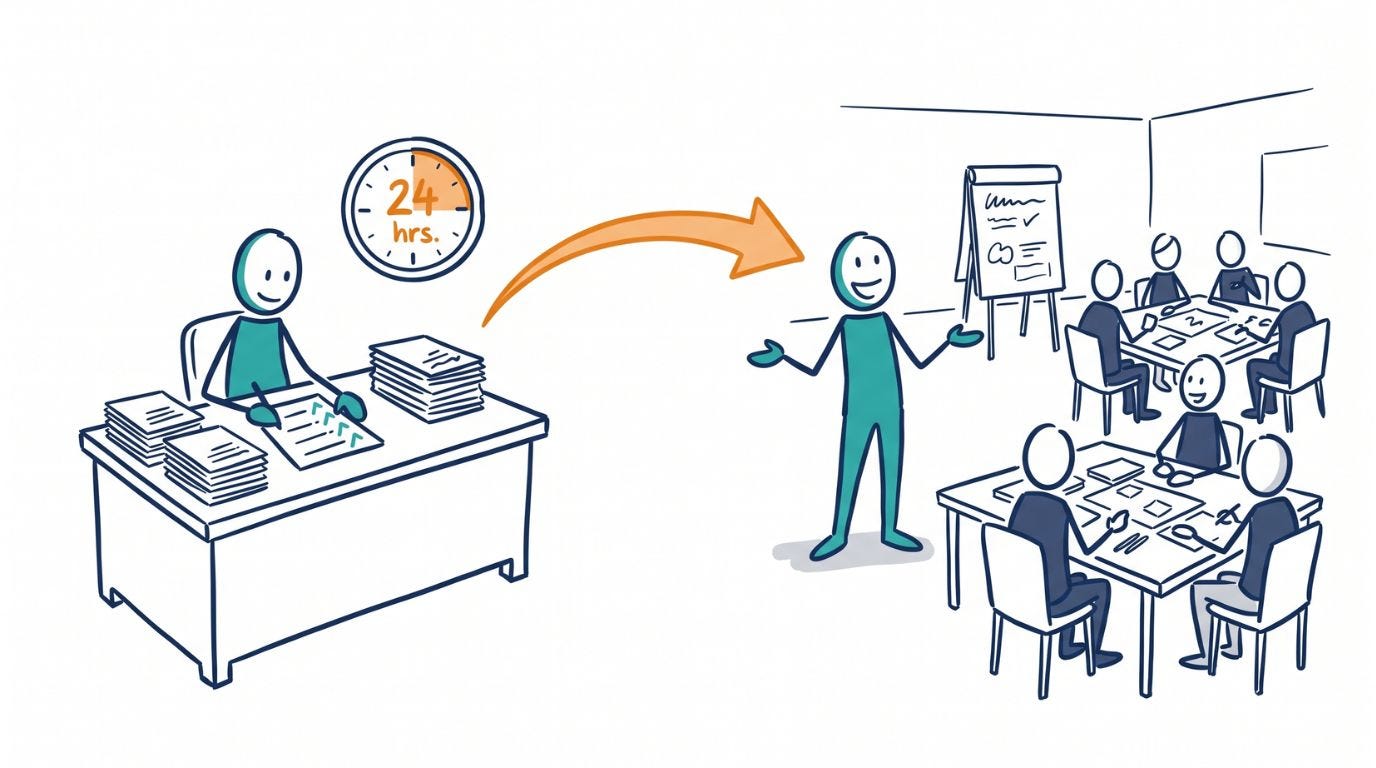
Most facilitators spend weeks on their workshop content and zero time on delivery prep. That’s backwards.
Design feels productive. You’re building something. You can see the slides, the activities, the flow. It feels like progress because it’s visible work.
The 24 hours before delivery feel like logistics. Room checks. Emails. Printing templates.
Small, boring tasks that don’t feel important next to the big creative work of workshop design.
But those small tasks determine whether your design works.
A perfectly designed activity falls apart when the room layout doesn’t support group work.
A carefully timed agenda collapses when you discover mid-session that two people in the room haven’t spoken since a project blew up three months ago.
The session starts before the session starts.
What you do in the final 24 hours is the bridge between the workshop you designed and the workshop you deliver.
Here are eight things to do the day before your workshop. None of them takes long. All changes how the session goes.
1. Visit the room
If you can get into the space the day before, go. Don’t just glance at it. Sit in it. Move through it.
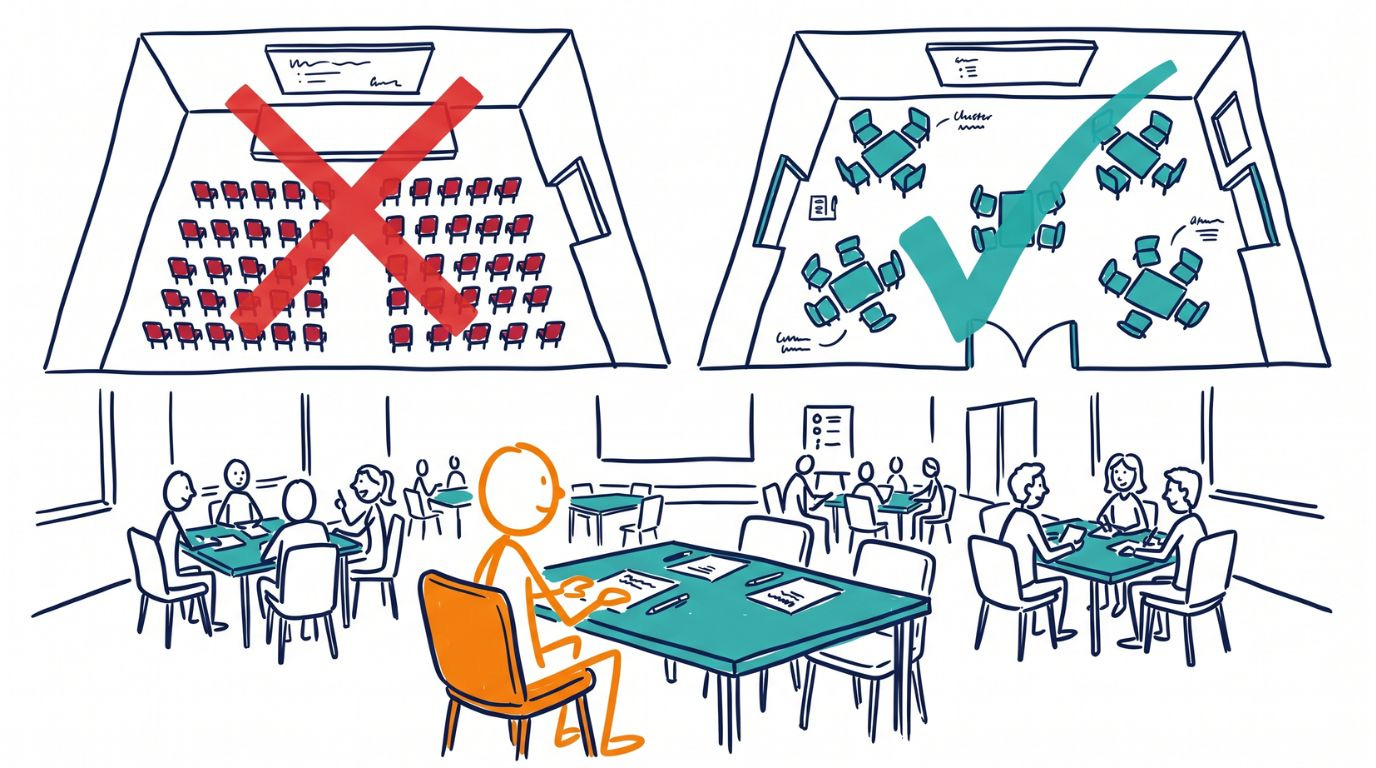
Check the layout first. If chairs are in rows facing a screen, that room is set up for a presentation, not a workshop.
Rearrange them into clusters of four to six. Clusters tell people “you’re going to work together” before you say a word.
Rows tell people “you’re going to sit and listen.” The furniture sets the expectation.
One facilitator I spoke with recently described arriving early for a two-day leadership session with 28 people.
Day one went well, but something felt off. She came back the next morning an hour early, sat in the participants’ chairs, moved through the space the way they would, and realised the layout was wrong.
She changed it overnight. Day two was a completely different session.
That’s the thing about room layout. You don’t notice the problem from the facilitator’s spot at the front.
You notice it from the participant’s chair. So sit in their seats. Walk their paths. See what they see.
If you can’t visit in person, ask for photos.
A room you’ve never seen is a room full of surprises you don’t want.
And if the room turns out to be a disaster on the day (projector dead, tables bolted to the floor, half the size they promised), you deal with it.
The best save I’ve ever seen: no flipcharts, no whiteboard, nothing worked.
The facilitator handed out A4 paper and ran the whole session as individual and pair work.
It ended up better than the original design.
But she could adapt that fast because she’d thought about the room in advance and knew which activities were flexible.
2. Send the pre-work question
One question. That’s all. Sent 24 hours before (three days is better, but one day still works).
Something like: “What’s the one thing about [topic] that frustrates you most?”
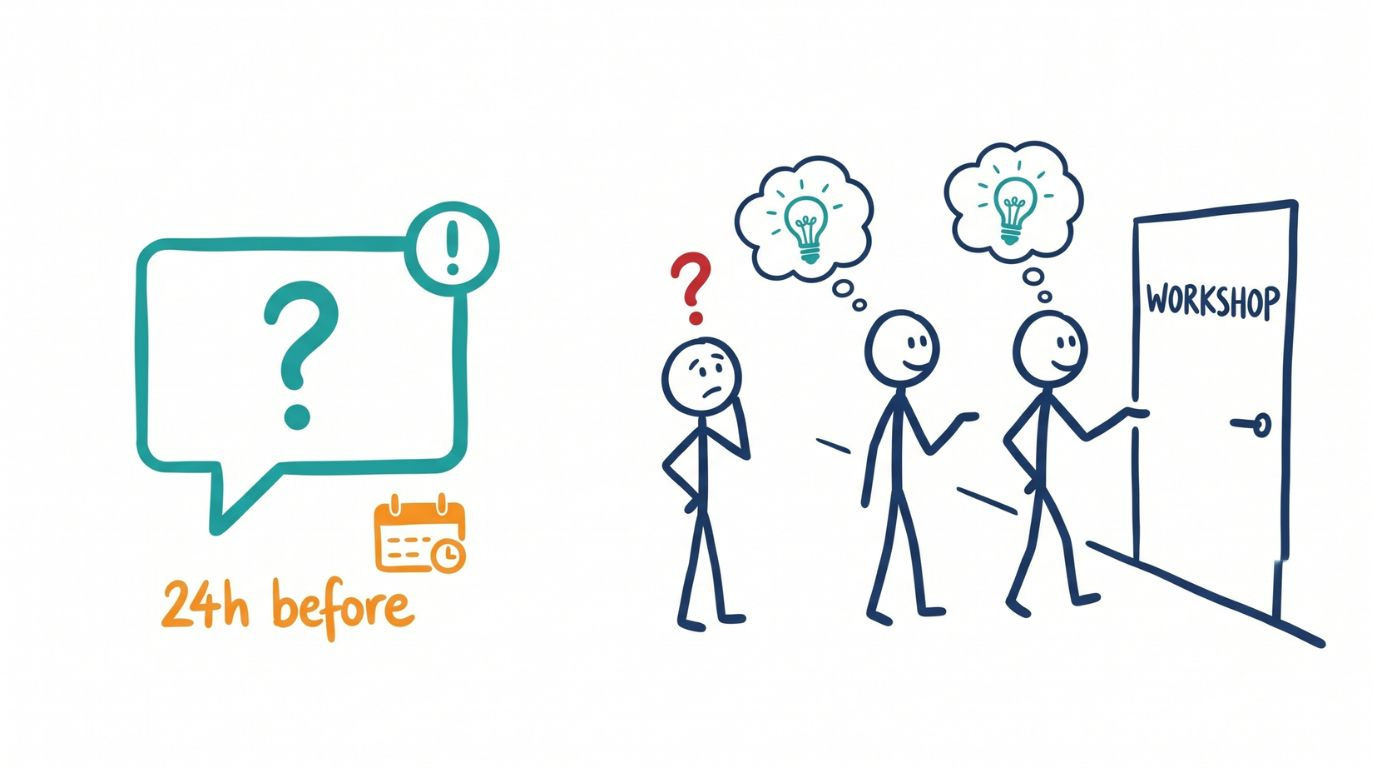
This does two things.
First, participants arrive having already thought about the problem.
Their brains aren’t starting cold.
You’ve bought yourself ten minutes of warm-up you don’t need because they’ve already warmed up at their desk the day before.
Second, it gives you data. If twelve people all mention the same frustration, you know where the energy is.
You know which part of your design will land hardest and which parts to spend less time on.
That one question turns you from a facilitator delivering a plan into a facilitator responding to the room’s actual needs.
The question matters, though.
“What are you hoping to get from tomorrow’s session?” gets polite, vague answers.
“What’s the one thing about [topic] you want solved by the end of the day?” gets you specific, useful information and starts focusing people on outcomes.
3. Write your opening sentence
Write down the first thing you’ll say when you open the session. Say it out loud once.
Skip the script, the self-introduction, the bio. Just one sentence that tells the room exactly what they’re going to produce.
“By 12pm, you’ll have a written conflict resolution process your team built together.”
“By the end of today, you’ll leave with three decisions your leadership team has been avoiding.”
If your opening sentence sounds vague when you say it out loud, rewrite it until it’s specific.
If you can’t make it specific, your outcome isn’t clear enough yet, and that’s worth knowing the day before, not five minutes in.
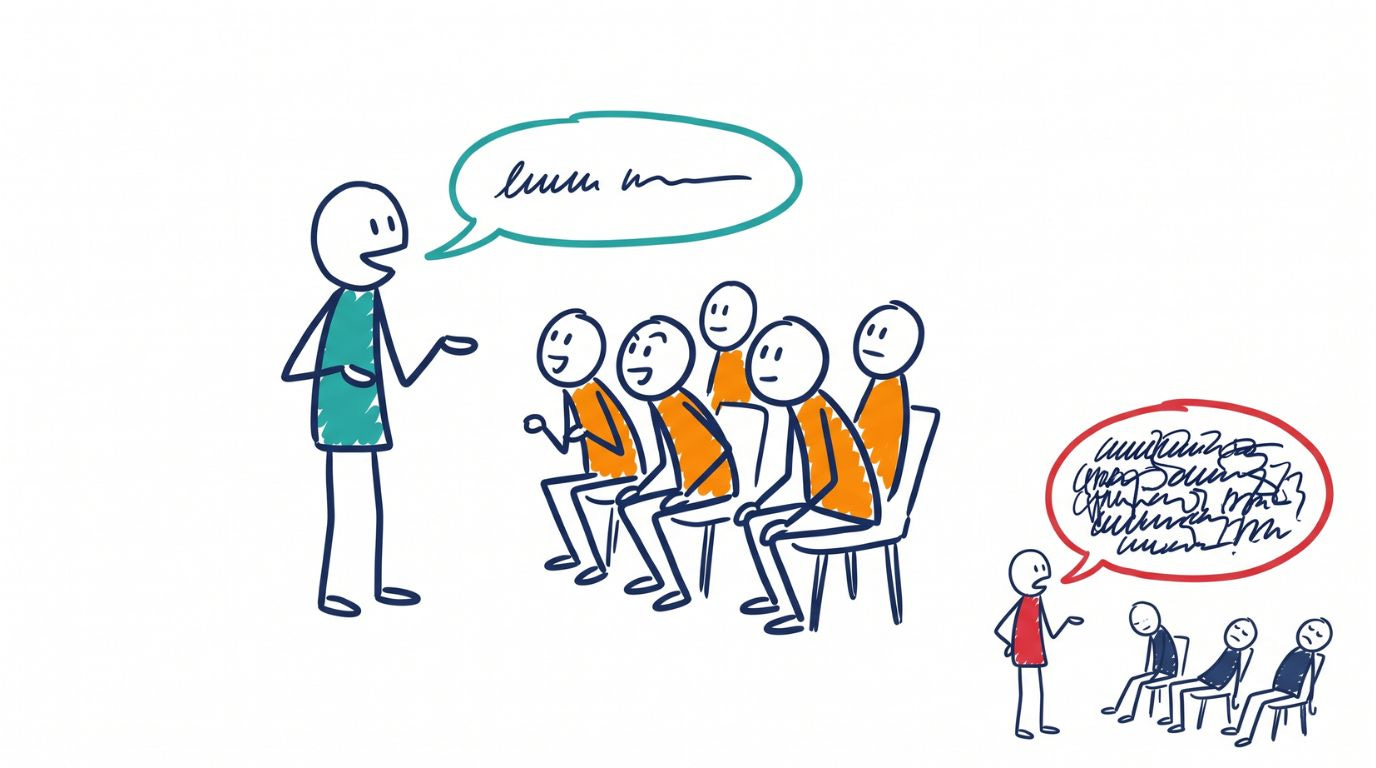
This sentence trains the room.
If you start by talking at people, they expect to be talked at for the rest of the day.
If you start with a clear, specific outcome and then immediately put them to work, they expect to keep working.
4. Brief the sponsor
If someone senior is opening the session, you need to tell them exactly what to say and how long they have.
This is not optional. This is the single most common source of derailed openings.
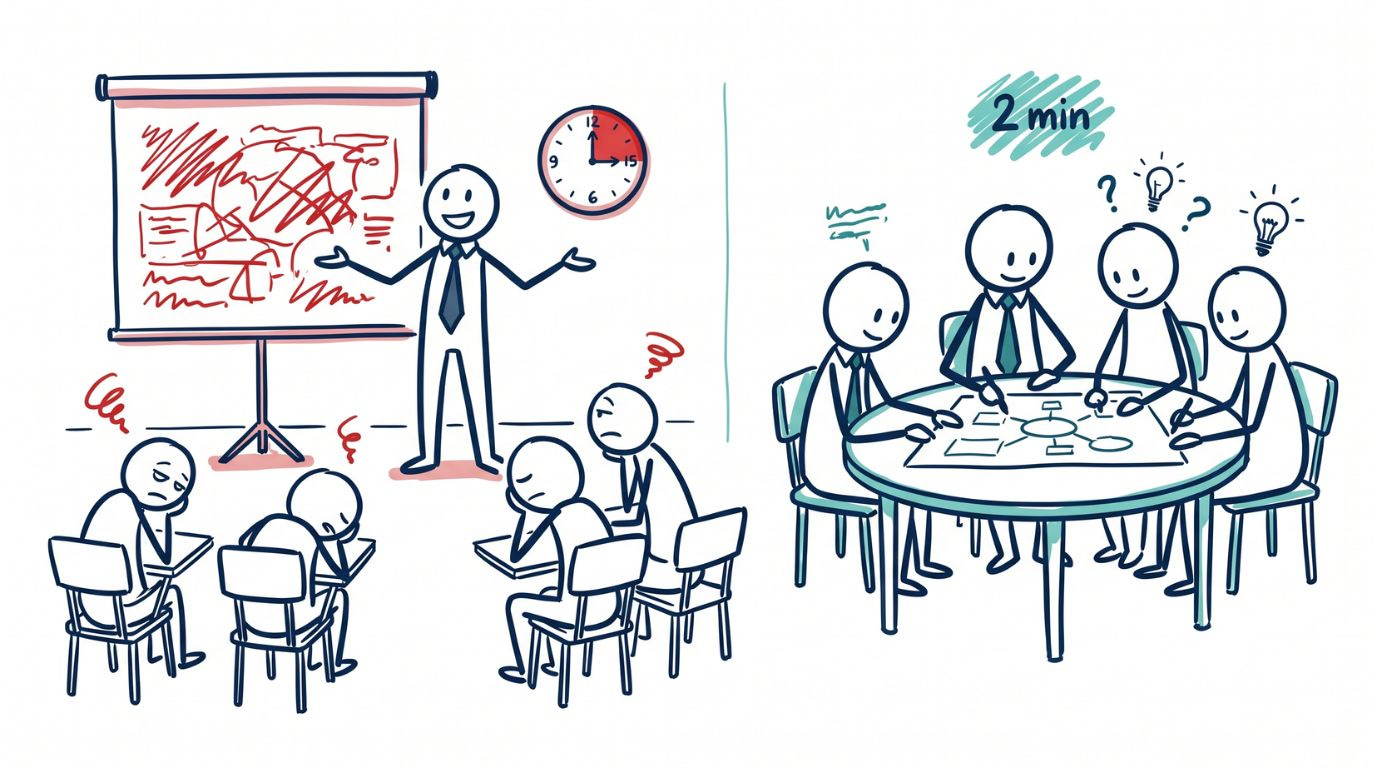
I’ve watched facilitators lose fifteen minutes because a senior leader “just wanted to set some context” and turned it into a strategy presentation.
The room’s energy shifted instantly from “let’s work” to “let’s listen.”
You can see it happen in real time. People lean back in their chairs. They stop looking at the materials on the table and start watching the screen.
Someone picks up their phone. And once participants are in listening mode, getting them back to working mode takes effort. Sometimes the morning never recovers.
Brief the sponsor on three things:
What to say. “Why this matters to you personally.” Not the strategic rationale. Not the project background. Why they, as a human, care about this topic. That’s what lands.
How long. Two minutes. Set the expectation clearly. “You’ve got two minutes. I’ll give you a nod when it’s time to wrap up.” Sponsors don’t ramble because they’re bad people. They ramble because nobody told them they had a time limit.
That they’re staying as a participant. This is the most important of the three. When the most senior person stays in the room, sits at a table, and works alongside everyone else, it tells the room two things: this matters enough for me to be here, and we’re all equals. When the sponsor opens and leaves, it tells the room the opposite.
5. Prepare the parking lot
This takes ten seconds. Blank flipchart in the corner. Write “Parking Lot” at the top.
That’s it. And it will save you from every off-topic hijack that would otherwise eat five minutes of your session while you figure out how to respond diplomatically.
Someone raises a valid point that’s completely off-topic.
You walk over, write it on the parking lot, and say: “Good point. I’m putting it here so we don’t lose it. We’ll come back to it.”
They feel heard. The group stays on track. You look like you planned for this, because you did.
Without a parking lot, you have two bad options: shut the person down (they disengage) or let the discussion continue (everyone loses five minutes).
With one, you have a third option that respects the person and protects the group’s time.
6. Set up materials before anyone arrives
Templates on tables. Pens at every seat. Flipcharts ready. Timer visible. Everything in place before the first person walks through the door.
First impressions matter.
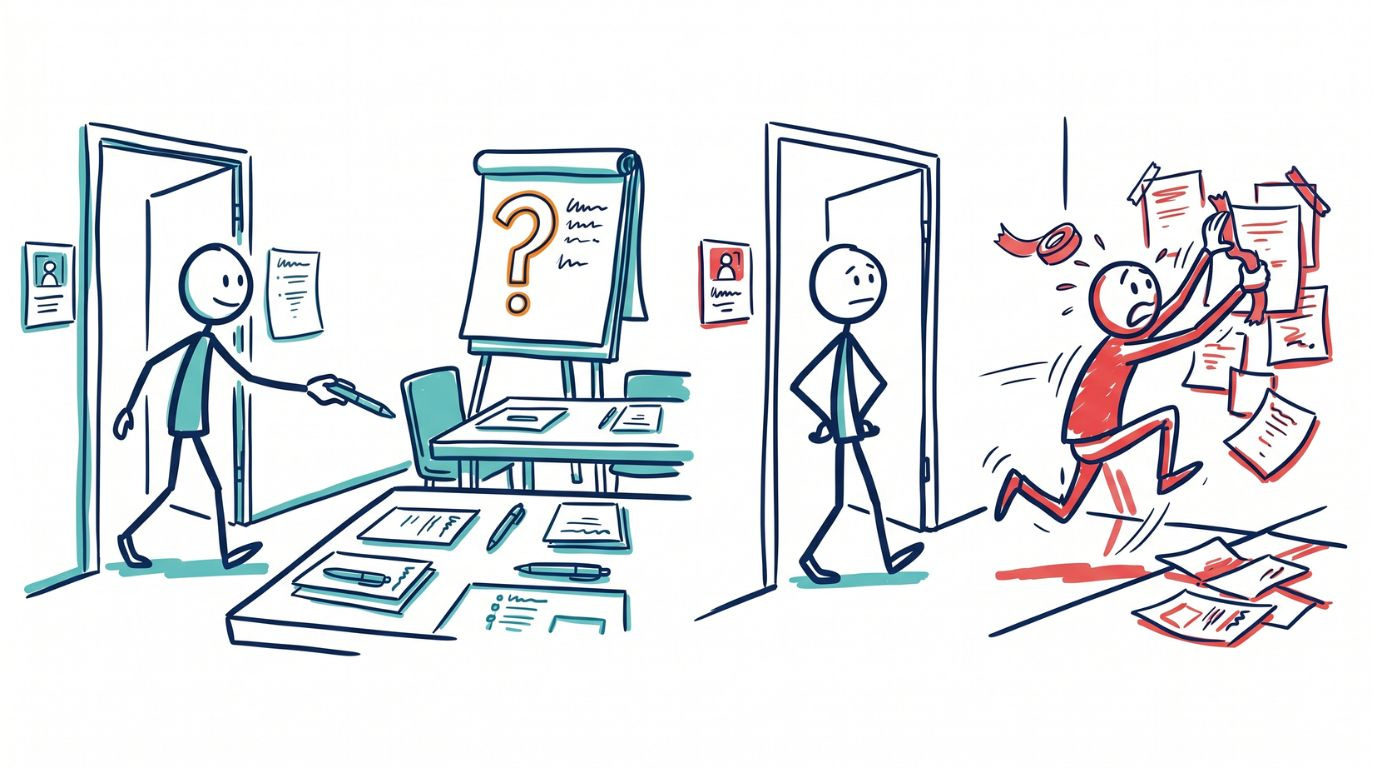
When participants walk into a room where materials are already laid out, they sit down and start reading.
They orient themselves before you’ve said a word. They pick up a pen. They look at the template. They’re in working mode before the session officially begins.
When they walk in and watch you taping flipcharts to the wall and handing out markers, the first thing they learn about you is that you’re not ready.
And if you’re not ready, why should they trust that the next three hours will be well spent?
First impressions happen before you open your mouth. The room is your first impression. Make it look like someone who knows what they’re doing set it up.
One useful addition: put a question on a flipchart at the front of the room.
Something visible as people arrive, like “What’s the one thing you want solved by the end of today?”
It gives early arrivals something to think about instead of sitting in silence checking their phones.
And it primes everyone for outcome-focused thinking before you’ve said a word.
7. Review the participant list
Pull up the participant list and spend five minutes thinking about who’s in the room.
Go beyond names and titles. Think about the relationships in the room and the history between people.
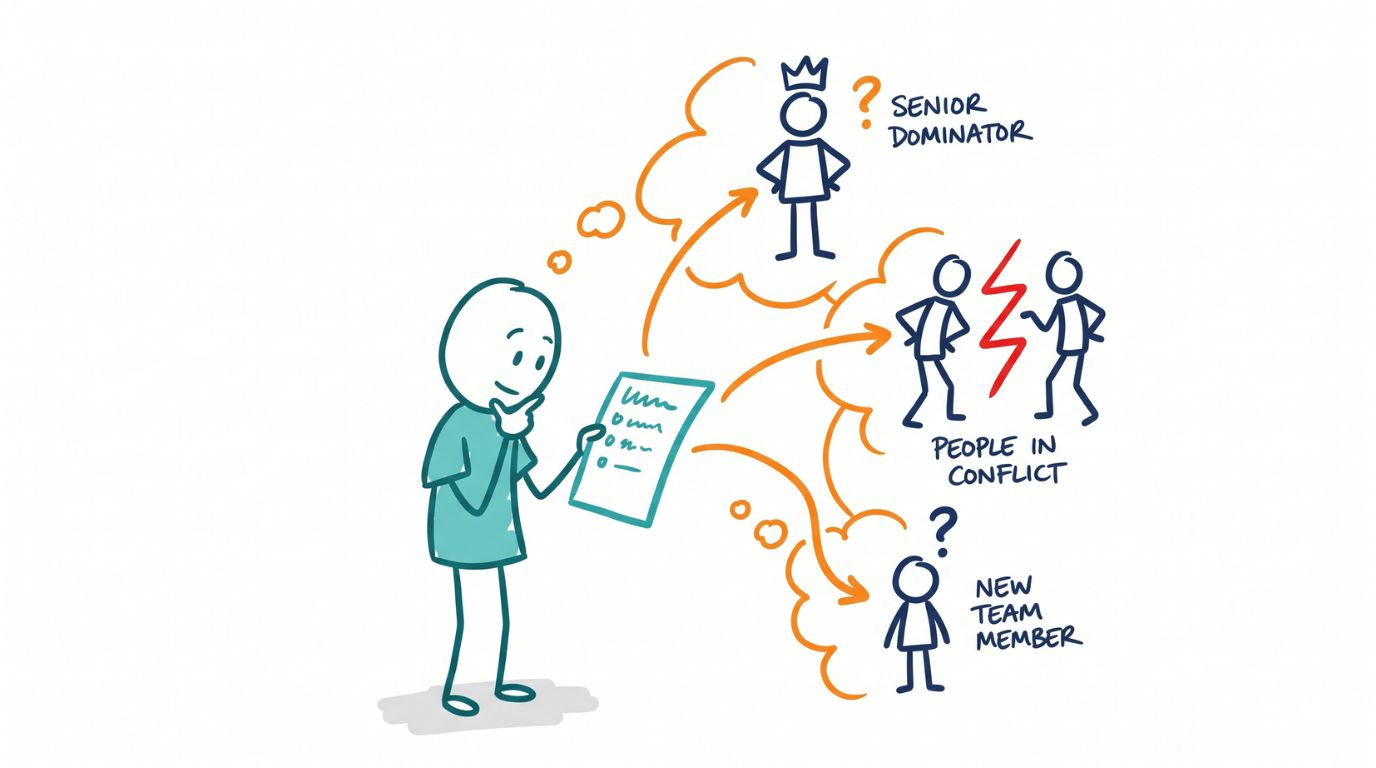
Knowing that the head of engineering is in the room and publicly disagreed with this initiative changes how you design your opening.
If two people on the list haven’t spoken since a project went sideways, that changes how you form groups.
A brand new team member changes which activities you choose and how you pair people up.
You can’t adjust in the moment for dynamics you didn’t know existed.
Five minutes of thinking about who’s in the room prevents thirty minutes of being surprised by what happens in it.
If you’re running virtual sessions, this review matters even more.
You don’t have the body language cues you’d get in person.
You can’t see someone’s arms-crossed resistance from a thumbnail on a screen.
Knowing who’s likely to push back, who tends to stay quiet, and who might dominate the chat is the only way to plan for it when your visual data is limited to a grid of faces.
8. Delete half your slides
Whatever you’ve prepared, cut it by 50%.
This gets the most resistance. Facilitators confuse content with value.
More slides feels like more preparation. More thoroughness. More “I’ve done my homework.”
All those extra slides just mean more talking. And more talking means less doing.
Every slide you remove is a minute participants get back. A minute where they’re building something together instead of watching you present.
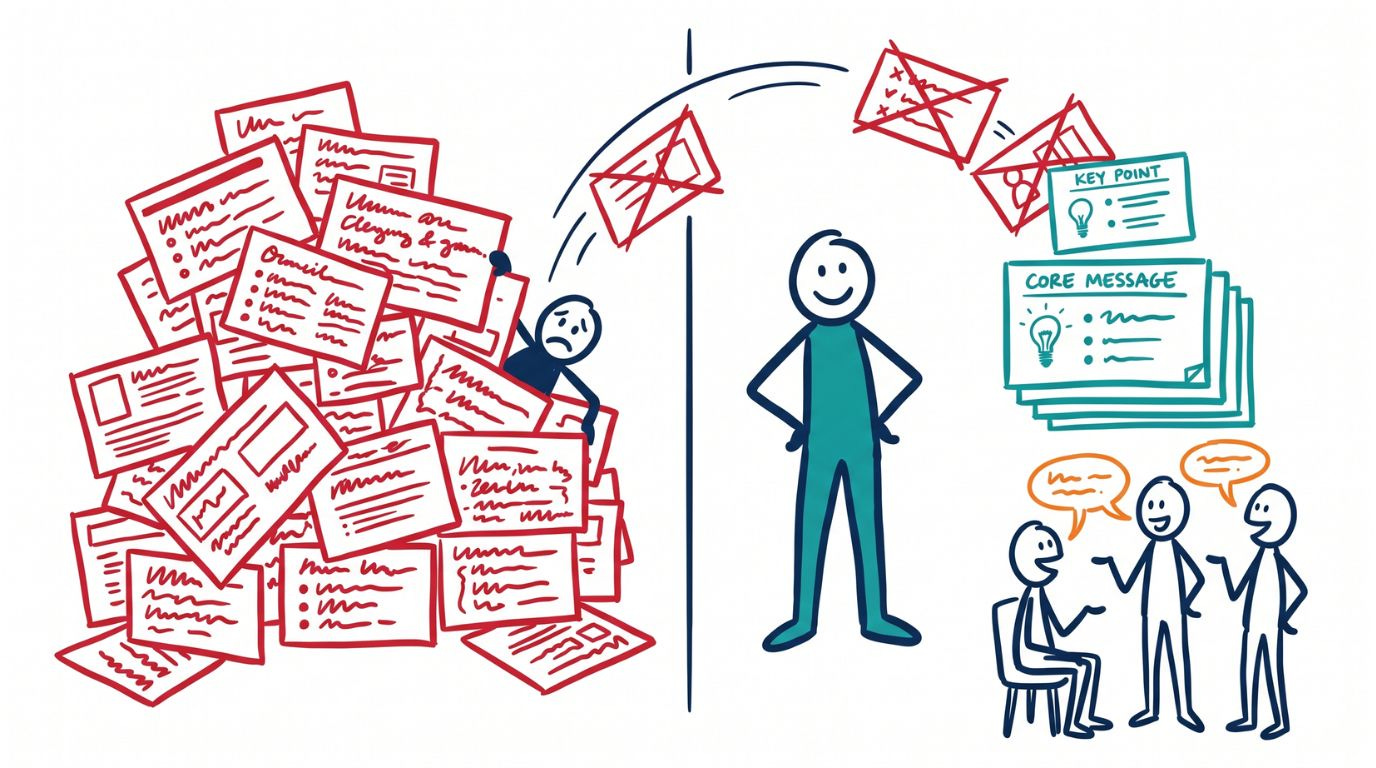
I used to walk into sessions with 30 slides and use maybe 12.
Now I design with 10 and use all of them.
Every slide earns its place by directly setting up an activity.
If a slide is just information I could say in one sentence, it doesn’t need a slide. It needs a sentence.
The test is simple: does this slide directly produce a participant outcome, or is it just information?
If it’s just information, say it in one line and move on. If it sets up an activity, keep it.
Some facilitators prefer zero slides. That works.
The more people are looking at a screen, the less they’re looking at each other.
And the conversations are where progress happens.
Zero slides or ten slides, the principle is the same: less content, more space for the room to work.
For anyone who can’t bring themselves to delete, try this: hide the slides instead.
Keep them in the deck in case you need to reference them, but don’t plan to show them.
You’ll find you almost never pull them back up.
And after a few sessions of not needing them, deleting gets easier.
Bonus: Know what you’ll cut on the day
Here’s a ninth move that didn’t make the original list but belongs here.
Before every session, mark each activity as either “load-bearing” or “cuttable.”
Load-bearing activities directly produce the outcome. They’re the activities the whole session exists to get to.
Cuttable activities support the outcome but aren’t essential. They build energy, provide context, or warm up the group, but the session still works without them.
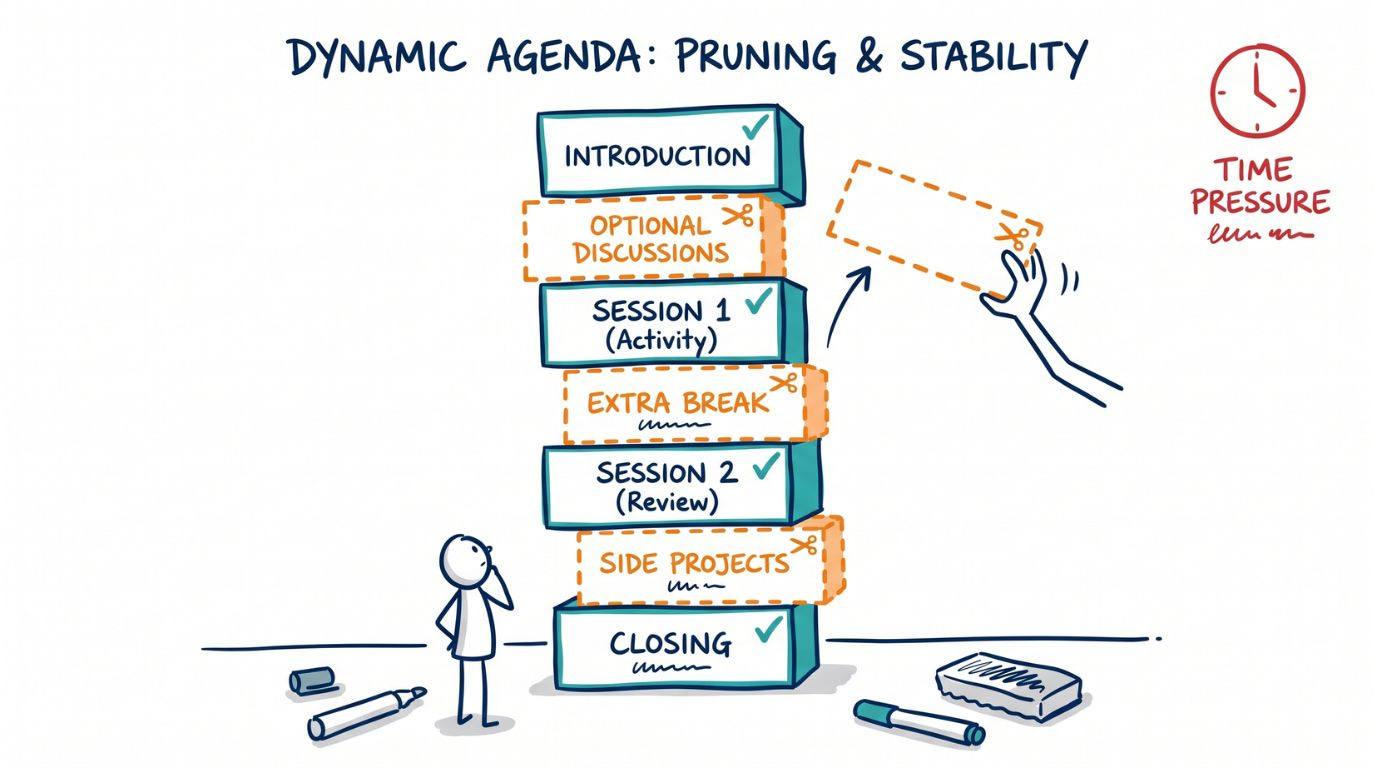
When lunch overruns by twenty minutes, or a discussion needs more time than you planned, or the sponsor’s two-minute opening becomes twelve, you already know what goes.
No panic. No on-the-fly redesign. You drop the cuttable activity and protect the outcome.
The best facilitators don’t just have a Plan A.
They know exactly which pieces of Plan A can be removed while keeping the session’s purpose intact.
That flexibility comes from a decision you made the day before, not from improvising under pressure.
The pattern across all eight of these moves is the same. Every single one is about the conditions your content lands in.
The room. The people. The energy. The expectations.
Get those right, and your design does what it was built to do.
A perfectly designed workshop delivered in the wrong room, with an unbriefed sponsor, to a group you didn’t think about, with too many slides and no pre-work, is a waste of everyone’s time.
The same workshop, delivered in a room you’ve set up, with a sponsor who knows their role, to a group you’ve studied, with half the slides and participants who arrived already thinking about the problem, is a different session entirely.
The best facilitators don’t wing the day before.
They design it with the same care they give the session itself. Because the session starts before the session starts.
And the facilitator who controls those 24 hours controls the room before they’ve said a word.
If this was useful, forward it to someone who has a workshop coming up this month. And if you’re not subscribed yet, you’ll get a new deep dive like this every week.
Such a great post Nick! I wish more facilitators would read this 😅
I was wondering how you would adapt this for virtual workshops? And hybrid ones?
This article is spot on @Nick Martin Item #2 gets overlooked so often. Thanks for sharing it.