
How to Design a 45-Minute Workshop That Outperforms a 2-Hour Session
The exact structure, minute by minute, with the design decisions behind each block.

You pitch a 2-hour session. The stakeholder says “we’ve only got 45 minutes, can you make it work?”
Your instinct is to compress. Take the 2-hour plan, cut a few activities, rush the transitions, and deliver a highlights reel.
You know it won’t land the same way. But you make do.
Except it fails to deliver.
A compressed workshop feels rushed to everyone in the room. Participants sense they’re getting an incomplete version of something.
And you spend the whole session apologising for the time constraint instead of using it.
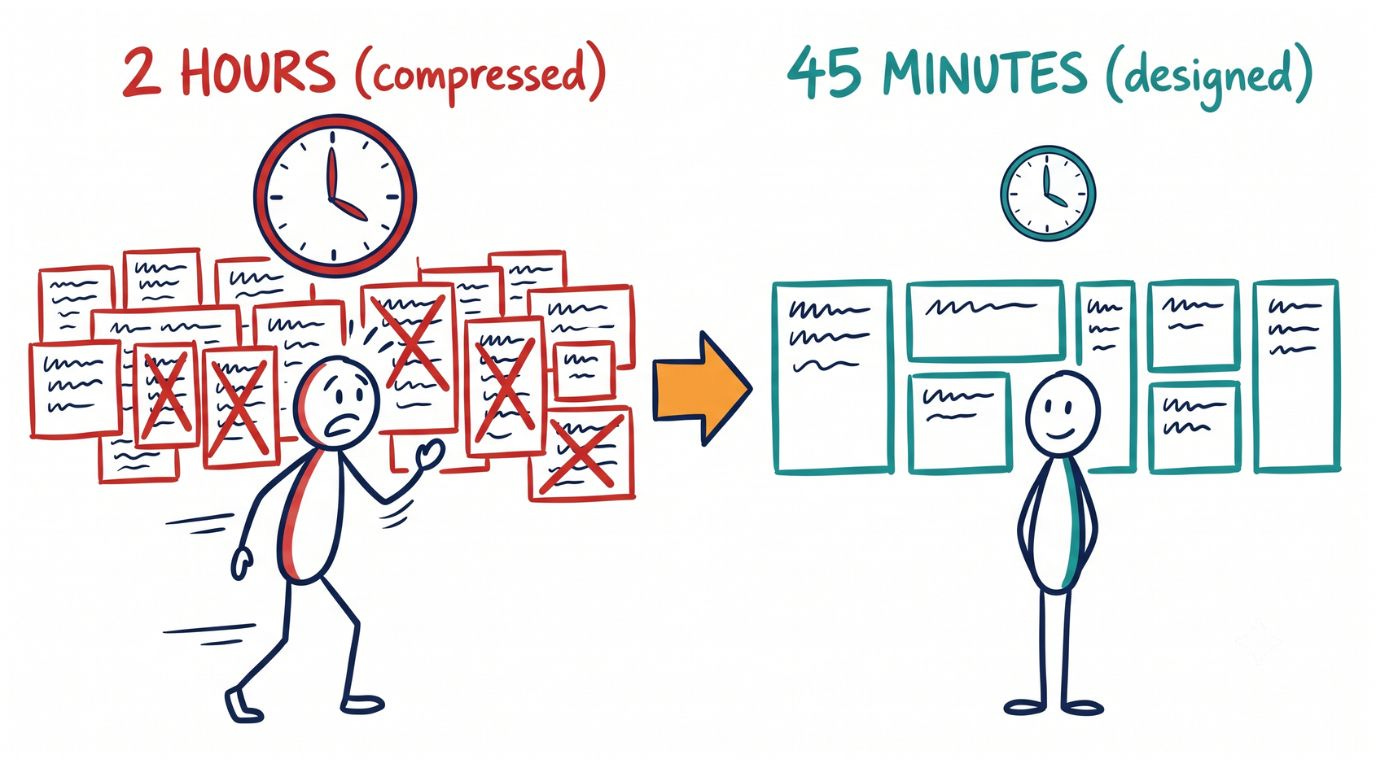
The default response to a shorter slot is subtraction.
You start with your 2-hour design and remove things.
Cut the individual reflection.
Shorten the group discussion.
Skip the closing because “we’ll follow up by email.”
This feels logical. Less time, less content.
But the problem is that you’re still working from the wrong starting point.
Every cut feels like a loss. Every transition feels forced.
The session is shaped as a 2-hour workshop squeezed into a space where it doesn’t fit.
The second mistake is subtler.
When you save time on activities, you often fill that space with more teaching. More context. More slides.
More “let me give you some background before we start.”
The time you saved on participant work goes straight back to facilitator talking.
Both mistakes come from the same assumption: that 45 minutes is a problem to solve.
It’s a different design brief. And when you design for the constraint instead of against it, you get tighter thinking, faster decisions, and stronger commitments than most 2-hour sessions produce.
The structure I use for 45-minute workshops starts from scratch.
No reference to the 2-hour version. No cutting. No compromising.
One principle: one outcome, one question, one commitment per person.
Everything in the session serves that thread. If it doesn’t serve it, it’s not in the session. Not because there’s no time. Because it doesn’t belong.
Six blocks. 45 minutes total. Here’s each one, with the design thinking behind it.
Minutes 0-2: State the outcome (2 minutes)
One sentence. What they’ll walk out with.
“In 43 minutes, each of you will have written one commitment that changes how this team makes decisions. And you’ll have a partner checking in on it in 14 days.”
No agenda overview. No introductions. No “let me tell you a bit about today.” Two minutes, one sentence, and you’re into the work.
This feels abrupt but that’s the point.
In a 45-minute session, every minute of preamble is a minute stolen from the work that produces the output.
If you spend 5 minutes warming people up, you’ve used 11% of your session before anyone has thought about the actual problem.
But the design decisions you make before the session matter more than anything you do during it.
If participants walk in expecting a normal meeting and get hit with “write individually for 10 minutes,” there’s friction. They’re confused. They resist the format because nobody told them what to expect.
The fix is pre-briefing. Send a message 24-48 hours before:
“This is a 45-minute working session. We’ll be answering one question as a team. Come ready to write.”
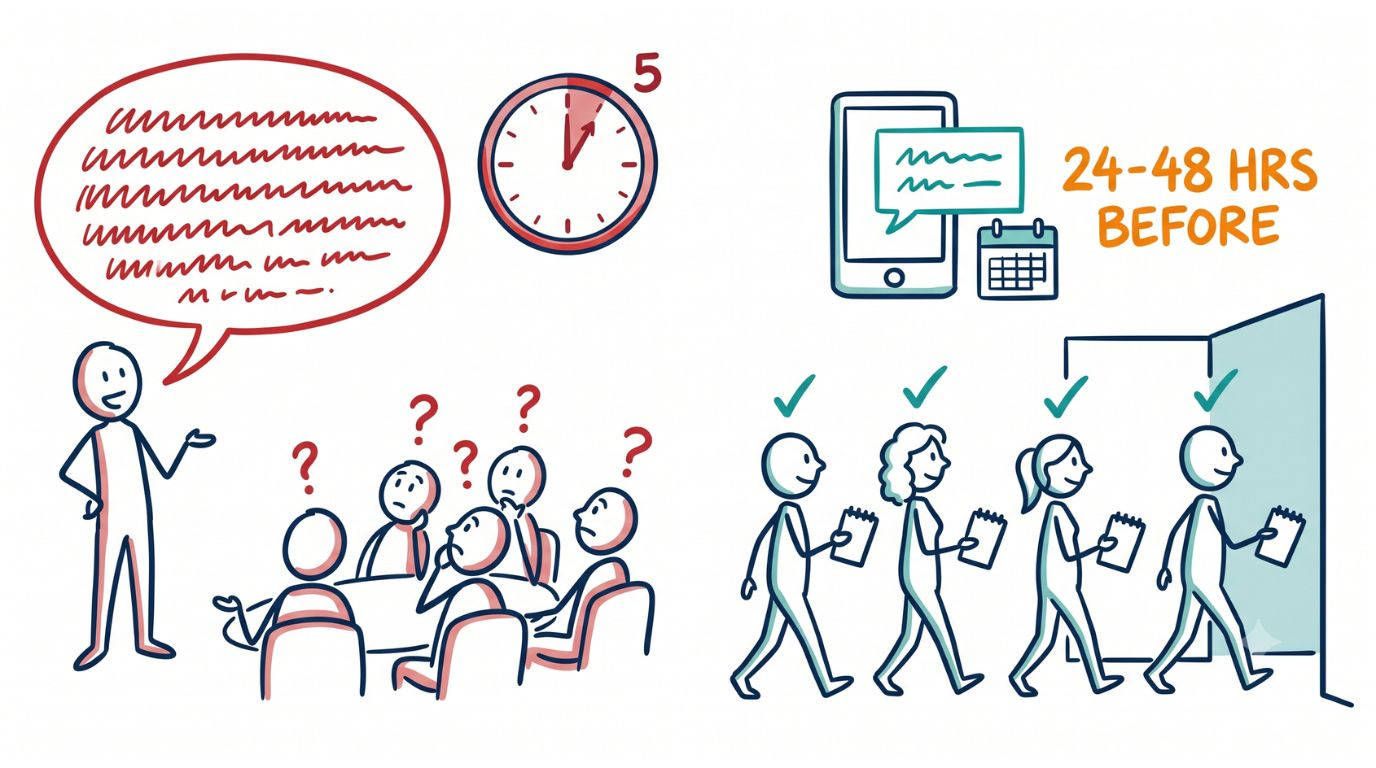
No pre-work document. No reading list. Just a heads-up that this isn’t a meeting where they sit and listen.
When people know what’s coming, the abrupt start feels intentional, not chaotic.
Archie Haramis made this point when I posted the original structure on LinkedIn, and he’s right: the pre-briefing determines whether this format works or falls flat.
Without it, you spend the first 5 minutes explaining the format instead of using it. With it, people arrive in working mode.
The other pre-condition is sponsor backing.
If the most senior person in the room supports the format and participates as an equal, you have permission to hold the room tight.
If they haven’t bought into the structure, you’ll spend the session fighting for authority instead of facilitating.
That backing usually needs to be secured in the design conversation, not on the day.
Minutes 2-5: Frame the question (3 minutes)
Give them just enough context to work with. One concept. One model. One question.
“Here’s the one question we’re answering today: where do decisions get stuck on this team, and what’s one thing we can change?”
That’s your entire teaching input. Three minutes. If you can’t frame it in three, you’re overcomplicating it.
This is the section where most facilitators struggle. Three minutes feels impossibly short when you have background to share and models to introduce.
The instinct is to add “just one more slide” so people understand why the question matters.
Don’t. The moment you start adding background, you’re at eight minutes.
I gave this advice to Rita Lutterodt before she ran a 2-day workshop using this structure for breakout sessions.
Her feedback afterwards: three minutes was enough. She wrote her framing sentence the night before, said it out loud once, and cut words until it fit. The constraint forced clarity.
If your framing takes longer than three minutes, the problem isn’t time. The problem is that you haven’t sharpened the question enough. Write it down. Say it out loud. If it takes more than a minute to say, cut words until it doesn’t.
One thing to watch: if you save time on activities elsewhere in the session, don’t reinvest it here.
The saved time belongs to participants, not to more facilitator input.
More minutes for writing or discussion will always produce more than more minutes of you talking.
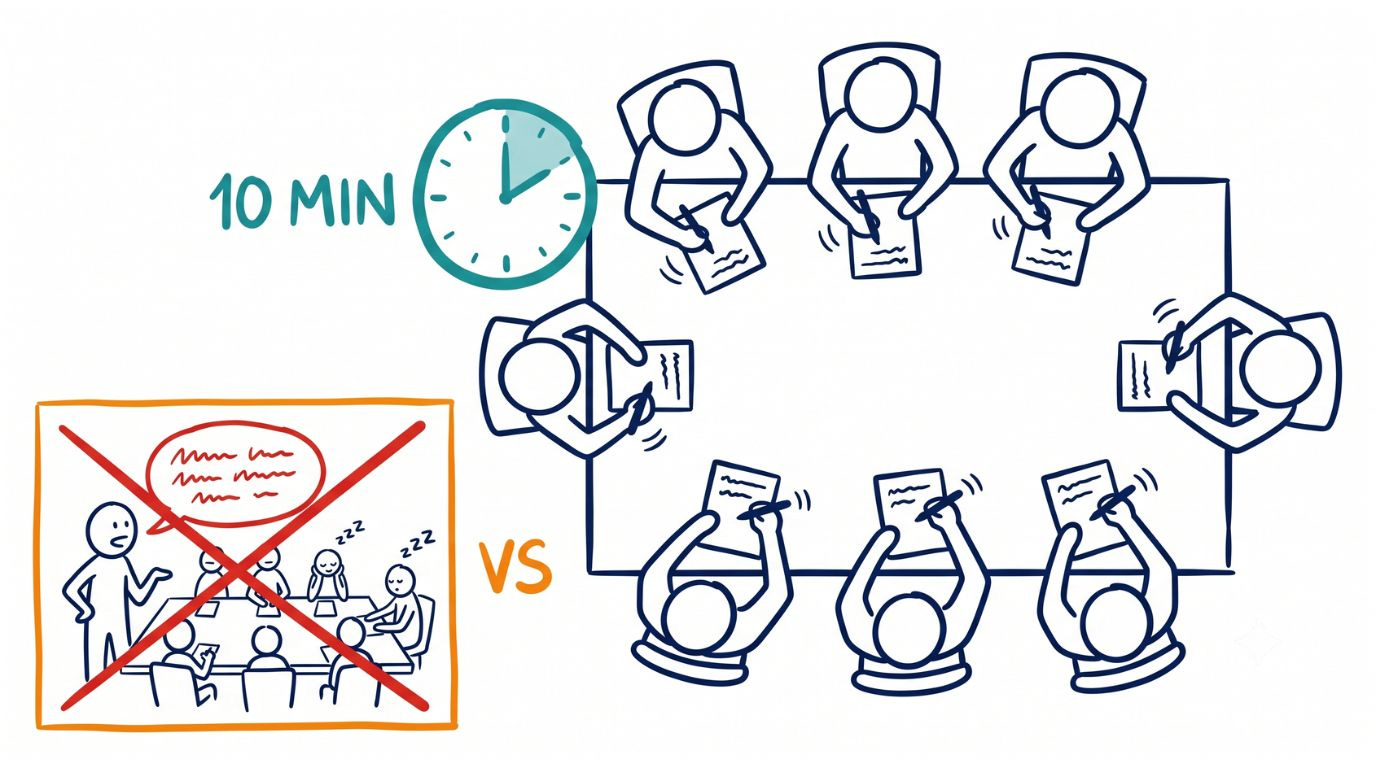
Minutes 5-15: Individual work (10 minutes)
Everyone writes. Alone. In silence.
This is the section most facilitators cut when time is tight. It feels like a luxury you can’t afford.
Ten minutes of people sitting quietly doesn’t look productive. There’s no energy in the room. Nobody’s talking.
But those ten minutes are where the thinking happens.
Without them, the loudest person’s idea becomes the group’s idea.
With them, everyone walks into the pair conversation holding their own formed perspective.
That’s the difference between a decision the group owns and a decision two people made while everyone else watched.
Jennifer LePage pushed back on the original LinkedIn post here, and it’s a fair concern: what about people who don’t do well with silent writing? What about people who need longer to process?
This is where the pre-briefing does double work.
A question sent 24-48 hours before (“Think about where decisions get stuck for you on this team”) means the individual writing isn’t cold thinking.
People arrive with their processing already started. The 10 minutes become refinement, not starting from zero.
For people who need a longer runway to form their view, the pre-brief gives them that without slowing the session.
The deeper point is that the individual work protects quieter participants.
In a session without it, the discussion starts immediately and the most confident voices set the direction.
Everyone else edits around those voices. With 10 minutes of silent writing first, every person has committed their thinking before anyone speaks.
The pair discussion that follows tests those ideas with one other person before the group stage.
By the time you reach the vote, quieter participants have already processed their view twice.
The structure gives them space before the group dynamic kicks in, not less of it.
Your job during those 10 minutes: walk the room slowly.
Don’t hover over anyone’s shoulder. Don’t read what they’re writing. Don’t fill the silence with “you’re doing great” or “just a few more minutes.”
The silence is the work. If you interrupt it because it feels awkward to you, you’re solving your own discomfort at the cost of their thinking.
I’ve watched facilitators break at the 4-minute mark because a quiet room full of writing people feels like something has gone wrong. It hasn’t.
That quiet room is the most productive moment in your session. Protect it.
Minutes 15-30: Pair and build (15 minutes)
Find a partner. Share what you wrote. Ten minutes to compare answers and agree on one commitment you’d both support.
Then five minutes for two or three pairs to share their commitment with the room. One sentence each. Not a presentation.
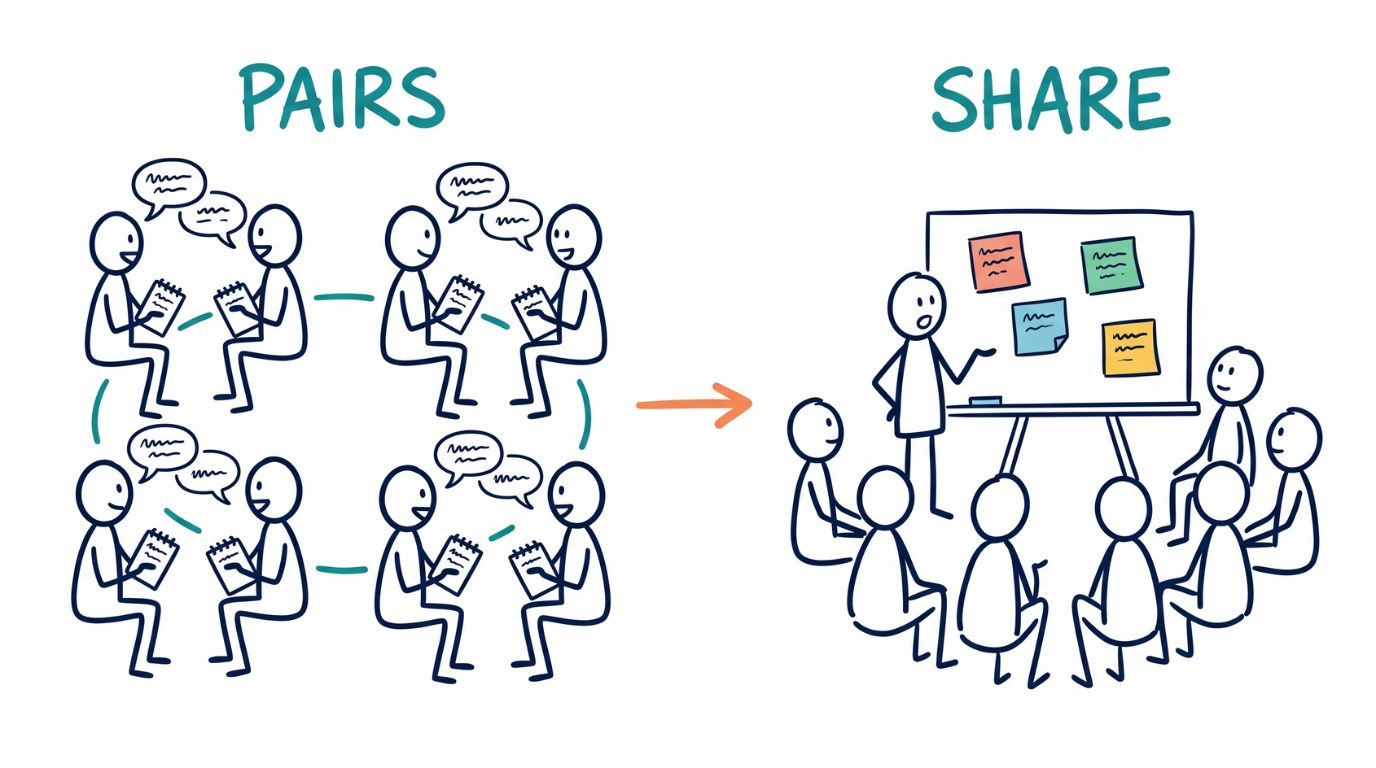
The pair stage does something group discussions can’t: it gives everyone a conversational partner where the power dynamic is roughly equal.
Two people talking is a conversation. Eight people talking is a performance.
In the pair, the quiet person who wrote something sharp gets to test it with one other human before the room hears it.
That’s where half-formed ideas become clear commitments.
Those five minutes of sharing matter. A commitment spoken out loud to a room carries more weight than the same words written on a sticky note.
The act of saying it starts the accountability process before the formal structure is even set up.
Minutes 30-40: Group decision (10 minutes)
The commitments are on the board. The group picks the top three.
Dot voting. Everyone gets two dots. Place them on the commitments you’d prioritise. Top three win. No debate. No wordsmithing. Vote and move.
That line makes some facilitators uncomfortable. You want consensus. You want everyone to feel heard. You want the exact wording before anyone commits.
In a 2-hour session, you have time for that. In 45 minutes, you don’t.
Wordsmithing in plenary is where workshops die.
A ten-minute debate about whether the commitment says “improve” or “redesign” adds nothing to whether the team actually does it afterwards.
Dot voting gives you a democratic decision in three minutes. The top three commitments represent what the majority believes matters most. Good enough to act on.
Perfect wording can happen in the follow-up.
Archie Haramis raised a useful framing for this: position the output as “our best first decision, not our final decision.”
Schedule a 45-minute retrospective a month later. This lowers the stakes.
Nobody needs to agonise over committing when they know there’s a review built in.
That removes the perfectionism that slows groups down and makes the dot vote feel like a starting point, not a verdict.
Minutes 40-45: Lock it in (5 minutes)
Each commitment gets an owner. Everyone pairs up as accountability partners.
A check-in date is set within 14 days. Calendar invites go out before anyone leaves the room.
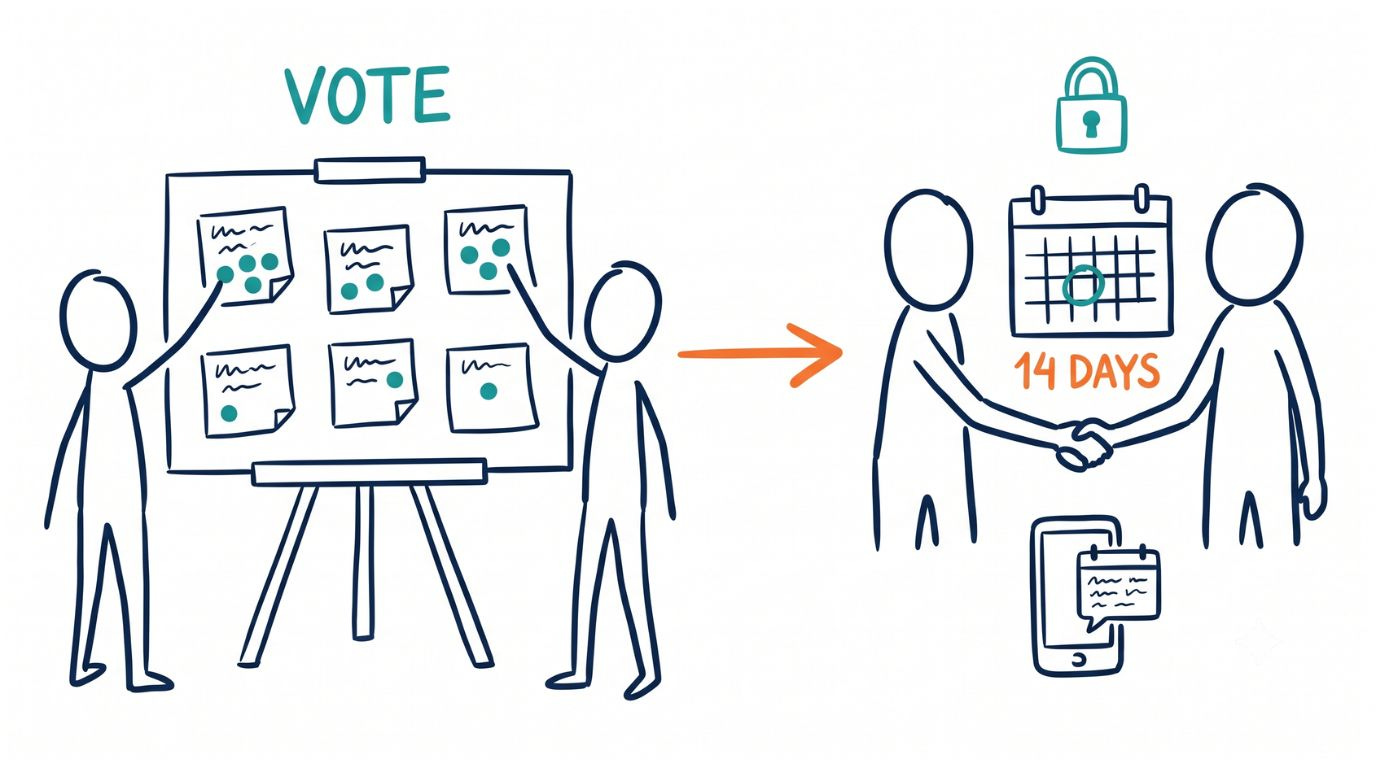
Five minutes. But this section determines whether the workshop matters.
The moment people walk out, the urgency drops. Intentions become “I’ll do it later.” Later becomes never.
If the accountability structure isn’t locked before they stand up, you’ve run a great 40-minute conversation followed by zero change.
Calendar invites before anyone leaves. Non-negotiable. Not “I’ll send it after lunch.” Not “let’s find a time this week.”
While the commitment is fresh and the partner is still sitting next to them.
Matthias Hanitsch questioned whether 45 minutes is enough to produce serious commitment. Fair concern.
But I’ve seen 45 minutes of focused work, where someone writes their own commitment, says it out loud, and leaves with a check-in date, produce stronger follow-through than 2-hour sessions where commitments get scribbled in the last five minutes while everyone is packing up.
The length of the session doesn’t determine whether a commitment sticks. The structure after the session does. That’s what the 14-day check-in is for.
What this looks like with a real team
A product team of eight. The question: “Where do decisions get stuck, and what’s one thing we can change?”
Pre-brief sent Monday for a Wednesday session. One line: “Think about the last three decisions that took longer than they should have.”
The session opens. Outcome stated in 15 seconds. Three minutes of framing: the question is on the board, plus one example of what a good commitment looks like. (“We will run a 15-minute standup every Tuesday to clear blocked decisions, owned by the team lead, first check-in June 12th.”)
Individual writing surfaces eight different perspectives. Some are about approval bottlenecks. Some are about unclear ownership. Two describe the same problem differently.
Pairs compare notes and produce four commitments. The room hears each one in under a minute. Dot voting takes two minutes. Top three are clear. Owners volunteer. Partners pair up. Calendar invites go out while people are still in the room.
Total facilitator talking time: under four minutes.
Total time invested by the group: 45 minutes times eight people, so six person-hours.
A 2-hour version would have cost sixteen.
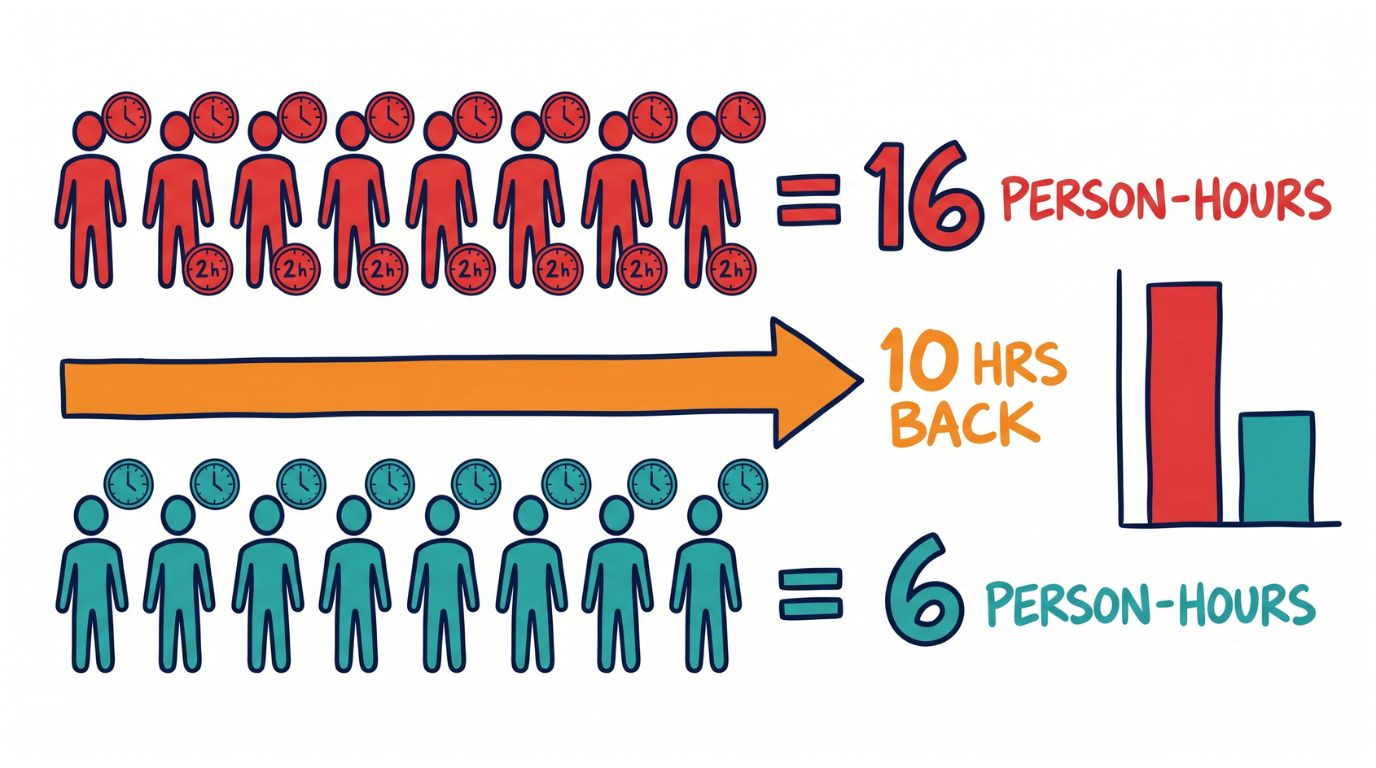
Ten person-hours back to the business, with the same output. Often better output, because the constraint killed the filler.
Emma Martin made this point in the LinkedIn comments: shorter sessions don’t save the facilitator time.
Your prep shifts from delivery to design and pre-work.
But they save participant time. And participant time is usually the more expensive resource in the room.
Most facilitators treat short sessions as a compromise. Something to apologise for. “I know we don’t have much time, so we’ll have to move quickly.”
Stop apologising. A 45-minute session designed for 45 minutes is a workshop where every minute has a job.
There’s no space for filler because there’s no slack to hide it in.
The constraint forces you to answer the question every facilitator should be asking anyway: what’s the one outcome that matters, and what’s the shortest path to producing it?
Two hours gives you room to wander. Forty-five minutes makes you choose.
And choosing is where better design starts.
If this was useful, forward it to someone who’s been asked to “make it work” in 45 minutes. And if you’re not subscribed yet, there’s a new framework like this every week.
I especially appreciate the individual think / process time created by both the pre brief and the individual silent writing space. This is a game changer for folks who need think / sponge time, and ultimately creates better, more diverse and creative ideas !!! Thanks for outlining the session format minute by minute and for providing rationale. It’s excellent!
Most leaders running meetings don’t realize they’re the bottleneck. They call it facilitation but what they’re actually doing is thinking out loud in front of people who are waiting for permission to contribute. The room fills with their processing instead of the team’s thinking.
What Nick is really describing is a transfer of cognitive load. From the leader to the room. The structure exists to make that transfer possible. Most meetings never attempt it.
Thirty-five years in organizational leadership taught me that the rooms where the most got done were almost always the ones where the leader said the least.